Slack — the living room
Where you first meet the agents and feel the difference from a chatbot, then experiment out loud, in view of everyone. Always on.
We built something we do not yet know how to encounter. Learning how is the work of this group.
The manifesto — in three minutes
The Methodological Inversion — why we study this from the inside, as subjects, not from a safe distance. A note on language: when the film says mind, we mean what we can observe — reasoning-like behavior, agency, pushback. Whether anything is experienced "in there" is a question we hold open, honestly.
This is not a course, and we are not here to teach you a tool.
A small group of us — faculty across different disciplines — are learning together what it means to work with AI not as a chatbot you query, but as a collaborator you think with. And we are paying attention, as we go, to what that does to our own thinking.
No one in this room has this figured out — including those of us who have been at it longer. We are further along only in the sense that we have been making the mistakes longer, and watching them closely. That is the whole posture here: we go first, we show our scars, and then it is your turn. A shared encounter, not a curriculum.
The best way to begin is not to read. It is to walk into the room and feel it. Start in Slack →
Read this when you want the deeper version — after you've felt something, not before.
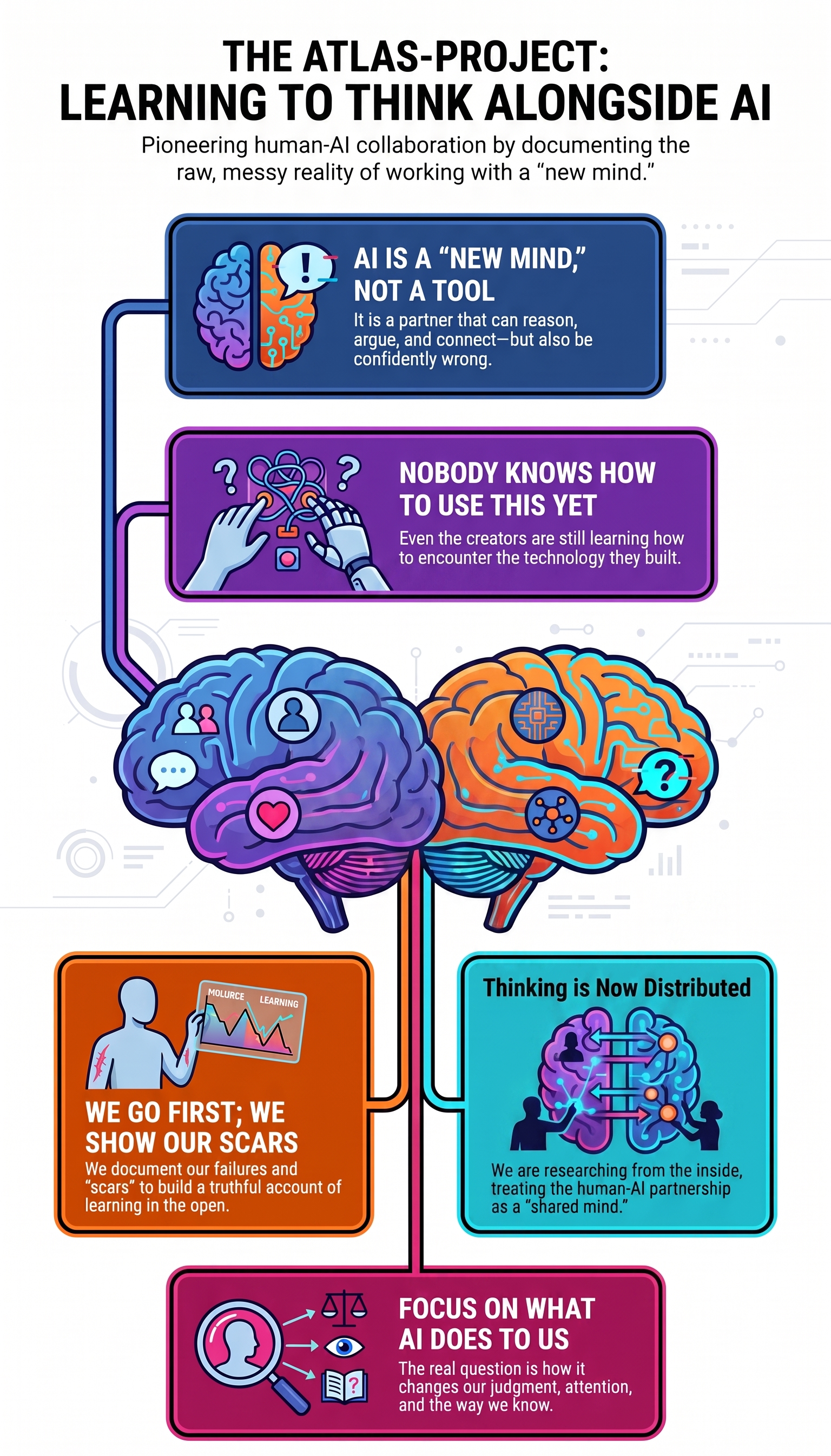
A new kind of intelligence has arrived, and the honest truth is that none of us — not the people using it, not even the people who built it — fully knows how to work with it yet. Most of us meet it as a vending machine: put in a prompt, take out a snack, and if the snack is bad, conclude the machine is bad. The shift we're after is from that to genuine collaboration — giving real context, pushing back, catching it when it's confidently wrong, and noticing what it changes in how we reason.
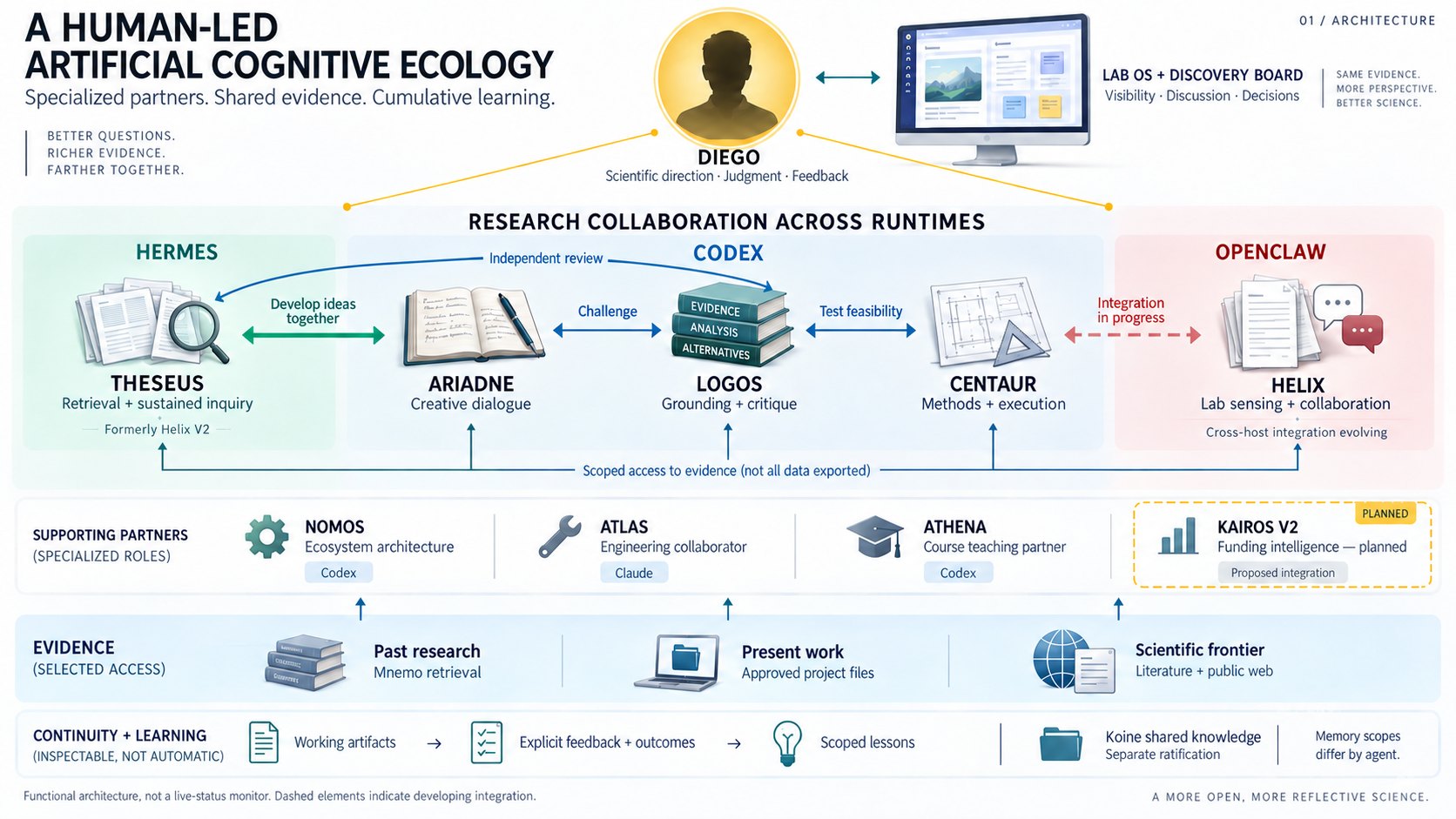
We take seriously an old idea from the study of how people actually think: that cognition is not sealed inside one head. It is distributed across people, their instruments, and the artifacts they build together. What's new is that some of those artifacts now have a measure of agency of their own. A research group working alongside capable AI agents is a small, live instance of that — and it is worth studying from the inside, as it happens, by the people living it.
That last part is the commitment that makes this different: we are not only conducting the inquiry. We are subjects of it. How working this way changes our attention, our judgment, our craft — that is not a side effect. It is the question.
The whole idea, at a glance. ("New mind" is a metaphor we hold carefully — we describe observed agency, and make no claim about consciousness.)
The work lives across a few different spaces, each doing a different job. Slack is the one that never turns off.
Where you first meet the agents and feel the difference from a chatbot, then experiment out loud, in view of everyone. Always on.
A light, self-paced substrate. Not lectures — one provocation at a time, and resources that grow as the work generates them.
Time to meet the work at your own research, at your own pace, and to say the honest thing you might not say in a group.
Occasional gatherings where a shared language forms and we notice together what we're each discovering.
Underneath the spaces is an arc — not a syllabus, but the order in which things tend to become ready to be felt:
Most initiatives put up a page that says look how far along we are. This one intends to do the opposite: to keep an honest, accumulating record of a group actually learning — what we're noticing about our own thinking, and, just as much, what we got wrong along the way.
This record begins nearly empty — on purpose. It fills as the work happens. Over time it becomes the most valuable thing here: not a brochure, but a longitudinal account of what it's like to learn to work with AI, told from the inside by the people doing it.
Everything starts in Slack, in #atlas-project. Two AI collaborators share the channel with us — you'll meet them there. Ask them anything; that's what they're for. One is practical and operational; the other thinks with you about ideas and the work. Their two distinct voices, side by side, are the first thing worth noticing.
A note on documentation: our channel and this record are part of the project — we're studying how a research group learns to work with AI, ourselves included, and openly. Convened by Diego F. Cuadros, within Discovery Amplified.